





Making a kilim for your home is not just about creating a rug. It's about incorporating history, texture, and character into your space.
When I understood that the kilim is characterized by the slitting technique, where the blocks of color interlock without forming knots, resulting in a fine and reversible rug, I realized that I was not looking at just any fabric… but at a piece of functional art.
Today I'll explain exactly how to make a kilim from scratch.

What is a Kilim and why is it perfect for the home?
A kilim is a traditional flat-woven rug, without pile, lightweight and completely reversible.
Unlike knotted rugs, this one has no visible knots. It's characterized by a slitting technique, where blocks of color interlock without forming knots, achieving a fine, reversible finish that works perfectly in modern spaces.
It is ideal for:
- Boho style rooms
- Minimalist bedrooms
- Rustic spaces
- Ethnic decoration
- Houses with a natural style
Materials needed to make a handmade kilim
To knit a kilim you will need:
- Loom (vertical or horizontal)
- Warp threads (strong cotton)
- Natural wool for the weft
- Needle or shuttle
- Fabric comb
- Geometric design or pattern
The quality of the wool is key. I recommend natural fibers to maintain flexibility and achieve that characteristic woven texture.
⭐The best Kilim deals for you

HAMID – Lori Kilim Rug with Oriental Design, 100% Wool, Kilim Rug, Handwoven, Hallway Rug, Living Room, Bedroom, Lounge, Entrance (D.3, 230×160 cm)
165,76€
Step by step: How to knit a kilim from scratch
1️⃣ Prepare the warp
The warp consists of the vertical threads that form the base. You must tighten them firmly on the loom.
A common mistake is not maintaining uniform tension, which distorts the design.
2️⃣ Start the plot
The weft consists of the horizontal threads that intertwine.
This is where the magic happens:
It's characterized by the slitting technique, where the colored blocks interlock without forming knots. When you change colors, you simply twist the yarn in its corresponding section.
That small space between blocks is what creates the typical groove of the kilim.
3️⃣ Create blocks of color
The kilim is based on defined geometric designs.
Each color block is worked separately.
Threads are not crossed as in other fabrics.
Thanks to this, the result is a thin, reversible rug, perfect for placing in any orientation of the home.

Common mistakes when making a kilim
- Do not maintain constant tension
- Using wool that is too thick
- Not planning the pattern
- Changing colors without respecting the slitting technique
When you respect that the blocks of color intertwine without forming knots, the finish is clean and professional.
How long does it take to make a kilim?
It depends on the size.
- Small Kilim: 1–2 weeks
- Medium Kilim: 3–4 weeks
- Large Kilim: 1–2 months
It is a slow process, but deeply satisfying.
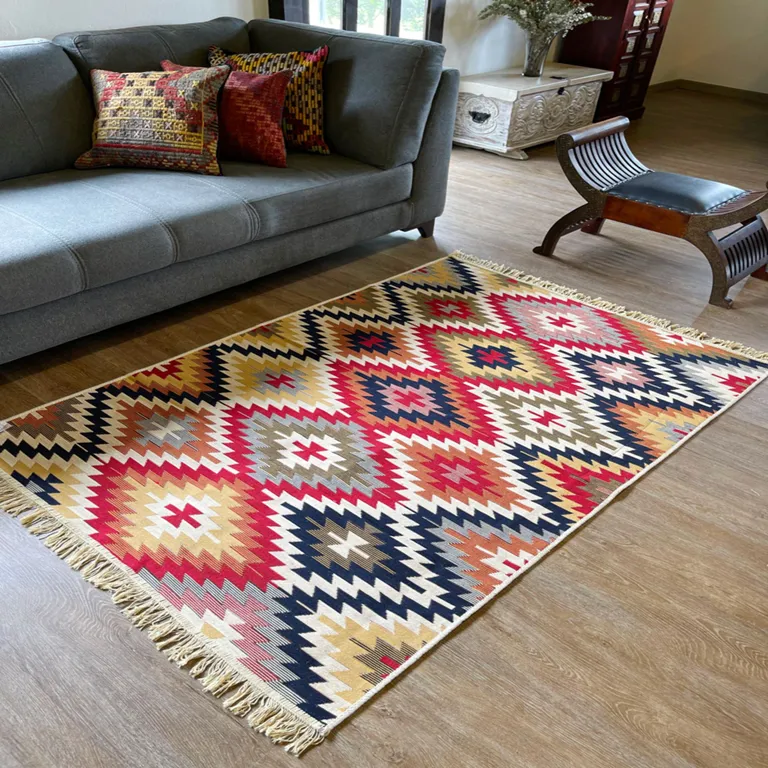
How to integrate a kilim into home decor
A handmade kilim provides:
- Textura visual
- Calidez
- Historia
- Carácter
Funciona increíble en:
- Neutral rooms
- Spaces with natural wood
- Scandinavian environments
- Modern bohemian style
Furthermore, being reversible, you can turn it around and refresh the atmosphere without changing the decor.
Is it worth making your own kilim?
Absolutely.
Understanding that it is characterized by the slitting technique and that the blocks of color intertwine without forming knots changes your perspective on traditional weaving.
You're not just making a simple rug.
You're creating a handcrafted textile piece that can last for decades. Conclusion
Making a kilim for the home is a handcrafted process that combines technique, patience, and design.
It's a fine, reversible rug.
It's a flat weave without knots.
It's tradition adapted to the modern home.
If you're looking for authentic, personalized, and soulful decor...
Kilim is the perfect project.